Start with WHY, then move to WHAT and HOW

February 22, 2011

This afternoon I had the opportunity to speak to 200 social media enthusiasts who were concluding an all-day conference on the role of social media during times of disaster.

I talked briefly about a future that will be driven more by strategy and less by the actual tools and technology. We must begin with why, not what or how.

Sometimes we find ourselves focusing on gadgets, widgets, tools and technology. Too many of us know how to tweet without knowing why we tweet. Too many of our agencies or organizations create Facebook pages without having a clearly defined purpose. Too often we assume that because we can, we must.

My desire for each of us is that we become more active in social media, but only in a purposeful way. We must avoid the temptation to join the parade just because everyone else is doing it. My hope is that we begin with strategy and then move to tactics, that we ask before we act, and that we think before we do.

May our mantra be:  Strategy first. Tactics second. Results always.


Being Organized in the New Era of Google

February 8, 2011

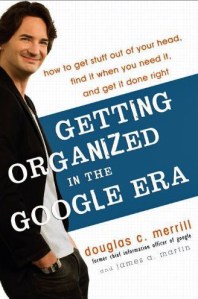
Seldom do I read every page of a book, but I just devoured every page of Getting Organized in the Google Era, an excellent book written by Douglas C. Merrill, the former chief information officer of Google.

Don’t be put off by its title—it’s not as nerdy as it sounds. My advice: Do yourself a huge favor and read this if you are still old-fashioned enough to:

  1. Use Microsoft Outlook to send and receive e-mail.
  2. Keep your appointments in an Outlook calendar.
  3. Store most of your important documents on the hard drive of your computer.
  4. Fear using “the cloud” for e-mail, calendar and document storage.
  5. Have no clue what is meant by the term “in the cloud.”

The very next book you should read. Trust me!

I don’t mean to be melodramatic or condescending, but I strongly believe we are veering towards obsolescence if we are still anchored to Outlook or to a Franklin-Covey planner for either our personal or work calendars. I also think we are seriously outmoded if we believe that the best way to organize our e-mails is to drag them from our inboxes into a hierarchy of folders and subfolders. In our globally-connected world, I can’t imagine anyone being unable to access his or her calendar, e-mail or documents from a smartphone or a computer.

To change ingrained habits we must start thinking differently. This exceptionally insightful book will help to change the way we think about the world. Just so you’ll know, this is not merely a book adulating the wonders of Google. Rather, the author describes ways to handle the blurring of our personal & professional lives. He talks about letting strategy drive our day-to-day decisions around tactics. He provides useful tips for customizing any organizational system to fit our personal needs, readily admitting that one size does not fit all.

To tease you into buying the book today, allow me to share these brief excerpts:

  1. In an era of widespread, inexpensive communications, knowledge simply spreads too rapidly for it to hold power for long. So there’s no point in trying to cram a ton of it into your head. A much better strategy is to have a system for storing and organizing knowledge so you can access or recall it when you need it.
  2. Because of search, you no longer have to neatly organize all your information the way you would with physical files, with a place for everything and everything in its place. Search is the foundation of the organizational systems we need today.
  3. The best e-mail system is the one that lets me quickly sort and search through years of messages. It’s accessible from any computer or any Internet-connect phone. It’s the one that’s easiest to use and has a huge amount of free storage, so I never have to delete old messages to make room for new ones. It excels at filtering out spam. That’s Gmail.

Your next steps are:  a) buy and read the book, b) underline key points and c) let me know what you think.


Rebecca Blackburn – Finding My Career Purpose

February 2, 2011

Rebecca Blackburn

In the past few months I’ve spent a lot of time dwelling on the purpose behind my career. I want to excel as a marketing communicator and serve a company to the best of my ability, but I have realized I also want to do more than that.

Yesterday morning I noticed the sun shining in the windows of our home. I soon realized the reason it seemed so beautiful was because it has been a long time since we’ve had a day filled with sunshine in Kansas City. That simple sunlight beaming in my window brought a smile to my face and joy to my heart – I feel like this is an illustration of what I want to do in my career.

Read the rest of this entry »


Can You Spot a Wrong Question?

January 26, 2011

The uncreative mind can spot wrong answers, but it takes a very creative mind to spot wrong questions. Antony Jay

I‘m not much impressed with the critics. They are the people who, at first glance, look smart and creative. They’ll sit in meetings and play the role of the Devil’s advocate. On the surface, they appear to be team players pulling in the same direction as the rest of us.

Look beyond the facade, though, and you’ll notice some interesting contrasts. Critics want to be perceived as creative thinkers, yet they demonstrate little creativity just by pointing out what’s wrong with something. They hope you’ll regard them as hard workers, yet in reality they have chosen the path of least resistance. Critics hope you’ll see them as high performers, yet they do most of their swimming in the shallow end of the pool.

Initially, critics might appear to be part of the solution, but actually they are part of the problem.

Again, I’m not much impressed with the creativity of someone who is quick to spot wrong answers. I’m impressed when someone can spot wrong questions, and I’m even more impressed when that person wrestles with finding the right questions.

In earning my master’s degree I took a class in market research. One key thing I learned was this:  To the get the right answers we must obsess with asking the right questions. The wording of a question often determines the answer.

Do you ask good questions? Do you find yourself mentally rewording and even rehearsing questions prior to asking them? That takes creativity, you know.

What is your motivation in asking questions? Do you want your questions to empower and add value? Or are you subtly trying to impress people by asking questions that are negative and destructive?

If we ask the right questions, I believe the right answers will magically manifest themselves. Agree?


Thinking with a Beginner’s Mind

January 12, 2011

In the beginner’s mind there are many possibilities, but in the expert’s mind there are few. Shunryu Suzuki

You are an experienced professional who knows what you’re doing. Right? Your education, your work history and your skills all combine to make you an expert in your chosen field.

It’s only natural if you want others to rely on you for your expertise, but be careful when you’re tempted to think of yourself as an expert. Being labeled an expert can lead to rigidity and inflexibility.

We gain experience as we learn from the mistakes of ourselves and others. Experience teaches us what works and what does not. Be cautious, though, because the more we become vested in the status quo, the more likely we are to get stuck in a rut.

I enjoy being surrounded by people who think with a beginner’s mind. Though they may be experienced and have reputations as “experts” they approach projects differently than do those who label themselves as experts.

A beginner’s mindset has these characteristics:

  1. Insatiable curiosity. A beginner is filled with wonder and looks at the world with a sense of awe. Like a child, a beginner asks lots of simple yet profound questions.
  2. Playfulness. The beginner has fun experimenting with different ideas and various options. A good beginner plays nicely in the sandbox and knows that teamwork can make the game even more fun.
  3. Flexibility. In the beginner’s mind there are many possibilities. Innovation and major breakthroughs come from people who are not rigidly defending the status quo.

My wish for the coming year is that you will remain forever young and that you will always be relevant because you are a beginner, not an expert.


What, Me Worry?

January 5, 2011

I have been through some terrible things in my life, some of which actually happened.—Mark Twain

In these tough economic times, it’s too easy to create worst-case scenarios and then start believing they will actually become our reality.

Too many leaders of nonprofit organizations ask, “What if our contributions dry up?” Then they make contingency plans to liquidate services core to their mission.

Too many patriotic Americans are manipulated by politicians who rally their base by crying, “The sky is falling.” Confidence and optimism spiral downward.

Too many frustrated workers cling to their miserable jobs because they envision scary scenarios where they might be destitute or homeless. Productivity declines as these hapless employees, paralyzed by fear, forfeit career satisfaction.

We can do better than that. In the coming year I hope that:

  1. Business leaders will acknowledge the threats they face and then have the courage and the vision to focus on the opportunities awaiting them.
  2. Elected officials will inspire constituents by talking more about they stand for rather than pandering for votes by talking about what they are fighting against.
  3. Talented workers will recognize that their greatest risk is taking no risk and that they will empower themselves to use their skills in ways no one could have imagined five years ago.

Sure, dark clouds loom on the horizon, but I challenge you to find a time in history when that was not true. In any situation, we can find something to fear. We can also find reasons for hope and optimism.

I find confidence and comfort in Christ’s words from the Sermon on the Mount when he said,

Do not worry about your life, what you will eat or drink, or about your body, what you will wear. Is not life more than food, and the body more than clothes? Don’t worry about tomorrow, for tomorrow will worry about itself. Each day has enough trouble of its own.

In other words, don’t worry!


2010 Blog Stats in Review

January 3, 2011

The people at WordPress.com sent me the following information on how this blog did in 2010. On the meter below, they rated the overall blog health as “Wow.” Here are some other interesting stats:

The Blog-Health-o-Meter™ reads Wow.

Crunchy numbers

A Boeing 747-400 passenger jet can hold 416 passengers. This blog was viewed about 5,000 times in 2010. That’s about 12 full 747s.

Read the rest of this entry »


The Extra Rocks We Carry

December 21, 2010

A new Facebook friend recently called on the phone. Actually, Gary is an old friend, although we haven’t communicated in years.

The last time we talked, neither of us had families, neither of us had been diagnosed with cancer and neither of us had yet launched our careers. In the course of getting caught up, I told him of my wild adventures with the American Red Cross and he regaled me with even wilder stories from his career as a trooper with the Colorado State Patrol.

We stretched each other’s memories as we recalled experiences we shared in our carefree, youthful days when we both lived there in Colorado. I’m sure our macho memories have marinated over the years and the stories are now relived with greater gusto than when they actually occurred.

One incident, though, needed no embellishment. It actually happened just like this: Read the rest of this entry »


Taylor Saalfeld — My Part in the Difference

December 15, 2010

Taylor Saalfeld

Guest Post by Taylor Saalfeld

Over the past few weeks, I have had quite a bit of time to sit with the question, “Why do you want to work in the nonprofit sector?”  And to be quite honest I have been wrestling with this question and how to state my reasoning more than I would have ever thought.  My struggle is a result of trying to capture my heart and place it in writing.  In my best attempts to do so, the following is what has resulted.

I want to make a difference.  “Well isn’t that the goal of every nonprofit entity operating today?” you may ask and to that I would respond, “yes.”  But my difference is a result of who I am and where I have come from.

On Thanksgiving, I was blessed with the opportunity to sit with my father and grandfather and watch a WWII documentary on the History Channel about the 8th Air Force.  I will never forget the emotions played on my grandfather’s face as he watched this documentary.  As a veteran, B-17 pilot in 8th Air Force, 34th Bomb Group, he was reliving his history and the pride for the difference that he, along with his fellow brotherhood of airmen, made was evident.  This pride I have only seen matched on the face of my father, who battled in a very different war.

Read the rest of this entry »


I Hate Fundraising When…

December 7, 2010

Tis the holiday season! As winter approaches, nonprofit solicitations are swirling around me faster than snowflakes in a December blizzard.

Though I’m no Scrooge, I’ll admit that I hate fundraising when it is…

  1. Not relevant. The fact that you need money is not my problem. You won’t get a contribution from me by telling me how desperate you are. My advice: Make your case by explaining how my world will be a better place when I give to your cause.
  2. Based upon guilt or fear. If your cause is worthy of my support, don’t play mind games to manipulate my behavior. My advice: Make me feel smarter by investing in your organization.
  3. Not differentiating. Every nonprofit is aggressively raising money, especially this time of the year. Unless you can show me how your cause is the best investment in things I care about, you’re just making noise in an already noisy world. My advice: Focus on the unique niche that only you can fill.
  4. Coerced. If I’m forced to give, you may achieve a short-term result. Trust me, though:  I’ll forever resent being strong-armed and I will look for ways to distance myself from your organization at the earliest opportunity. My advice: Give me a choice and invite me to voluntarily join your team.
  5. Treated as an end objective. Fundraising is a means to an end. It’s purpose is to help an organization have adequate resources to fulfill its mission. A nonprofit does not exist to raise money, but rather it raises money so it can continue to exist. My advice: Talk more about your mission and less about how much money you need.
  6. More interested in my money than in me. If we don’t have a relationship, then I’m probably not going to give. Any farmer knows you cannot reap a harvest until you’ve planted the seed, nurtured the crop and waited patiently for nature to take its course. My advice: Give me ways to make philanthropy a natural expression of my relationship with your organization.