Seldom do I read every page of a book, but I just devoured every page of Getting Organized in the Google Era, an excellent book written by Douglas C. Merrill, the former chief information officer of Google.
Don’t be put off by its title—it’s not as nerdy as it sounds. My advice: Do yourself a huge favor and read this if you are still old-fashioned enough to:
- Use Microsoft Outlook to send and receive e-mail.
- Keep your appointments in an Outlook calendar.
- Store most of your important documents on the hard drive of your computer.
- Fear using “the cloud” for e-mail, calendar and document storage.
- Have no clue what is meant by the term “in the cloud.”
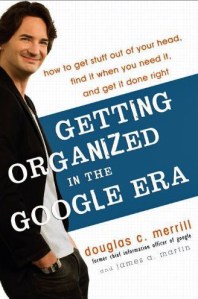
The very next book you should read. Trust me!
I don’t mean to be melodramatic or condescending, but I strongly believe we are veering towards obsolescence if we are still anchored to Outlook or to a Franklin-Covey planner for either our personal or work calendars. I also think we are seriously outmoded if we believe that the best way to organize our e-mails is to drag them from our inboxes into a hierarchy of folders and subfolders. In our globally-connected world, I can’t imagine anyone being unable to access his or her calendar, e-mail or documents from a smartphone or a computer.
To change ingrained habits we must start thinking differently. This exceptionally insightful book will help to change the way we think about the world. Just so you’ll know, this is not merely a book adulating the wonders of Google. Rather, the author describes ways to handle the blurring of our personal & professional lives. He talks about letting strategy drive our day-to-day decisions around tactics. He provides useful tips for customizing any organizational system to fit our personal needs, readily admitting that one size does not fit all.
To tease you into buying the book today, allow me to share these brief excerpts:
- In an era of widespread, inexpensive communications, knowledge simply spreads too rapidly for it to hold power for long. So there’s no point in trying to cram a ton of it into your head. A much better strategy is to have a system for storing and organizing knowledge so you can access or recall it when you need it.
- Because of search, you no longer have to neatly organize all your information the way you would with physical files, with a place for everything and everything in its place. Search is the foundation of the organizational systems we need today.
- The best e-mail system is the one that lets me quickly sort and search through years of messages. It’s accessible from any computer or any Internet-connect phone. It’s the one that’s easiest to use and has a huge amount of free storage, so I never have to delete old messages to make room for new ones. It excels at filtering out spam. That’s Gmail.
Your next steps are: a) buy and read the book, b) underline key points and c) let me know what you think.



 Posted by Duane Hallock
  I communicate with passion and purpose to inspire those searching for beauty and truth.
 Duane's Dartboard