Alana – An Inspiring Graduate Committed to Service

June 23, 2011

I first saw Alana as she began working as a volunteer in the Red Cross shelter. We talked briefly and I learned she was a high school English teacher.

On her first day she demonstrated that she was there to work hard. I watched as she completed her assigned tasks and then found other work to do. She swept the floor, moved boxes and served food. She later took it upon herself to organize the shelter’s library of donated books and to teach a girl how to shoot a basketball. Read the rest of this entry »


Nancy – An Inspiring Survivor of the Tornado

June 22, 2011

I first met Nancy in the dining room of the Red Cross shelter. I was about to be interviewed by a TV reporter, and just as the interview was set to begin, this woman approached. She didn’t say anything. She stood there smiling at me. By looking at her color-coded wristband, I knew she was a resident of the shelter, someone who lost her home in the tornado.

Not having the option of ignoring this woman, I asked how I could help. She said, “I want to talk to the reporter.” Being a public affairs officer, I knew from experience that those most eager to talk with the media are people who typically want to air a complaint. With the reporter listening, I inquired what was on her mind. Still smiling, she replied, “I want to tell her how great the Red Cross is and how much we appreciate what you are doing here for us.” Read the rest of this entry »


Marie – An Inspiring Volunteer and Storm Victim

June 21, 2011

Before the monster tornado struck, Marie was an active volunteer with the American Red Cross in Joplin. The night the tornado hit, Marie lost her apartment and most of her personal possessions.

Unhurt, she began driving through the debris towards help. Along the way, she helped others, even pulling an injured truck driver to safety. When the debris made driving impossible, she began walking. Along the way, she helped with the initial search and rescue efforts, checking to see if anyone needed help. Read the rest of this entry »


People Who Inspired Me in Joplin

June 20, 2011

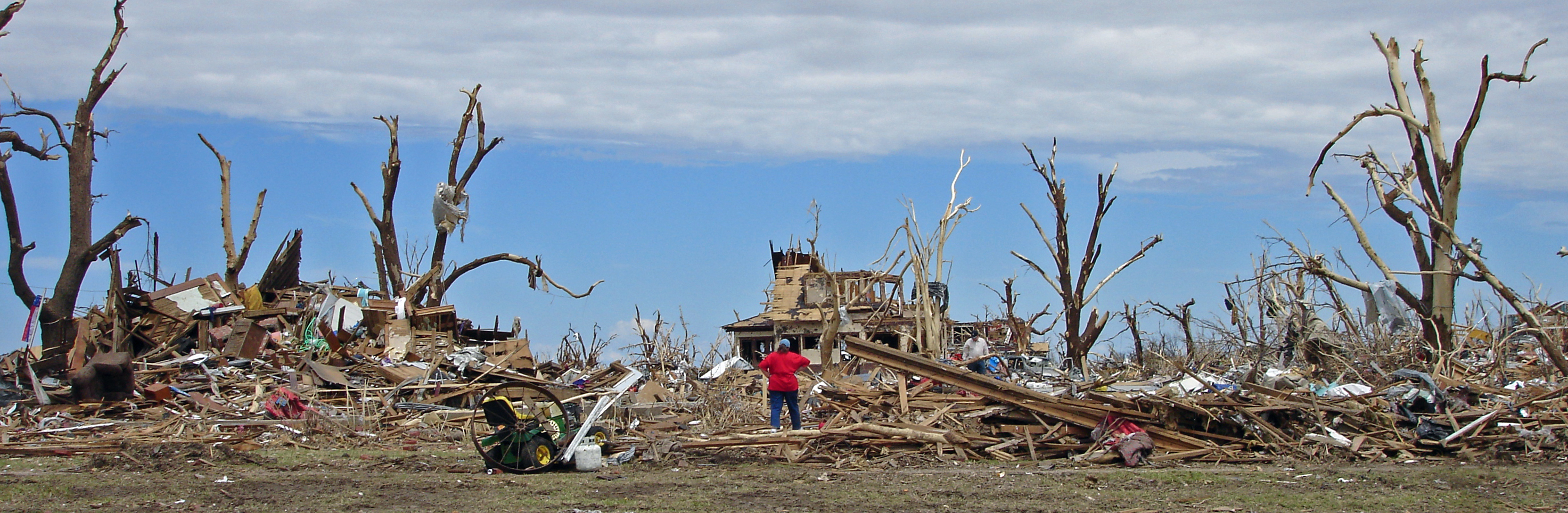
I spent two weeks in Joplin, Missouri immediately following the EF-5 tornado that destroyed much of that small town. I was there as a member of the disaster relief team of the American Red Cross.

In Joplin I talked with many survivors of the storm. I toured the indescribable destruction inside the tornado’s footprint. I even became acquainted with several of the people who lost their homes and were staying in the Red Cross shelter.

The more I got to know the people of Joplin, the more I was inspired by them. Although they seemingly had lost so much, they were grateful for what they still had. Although they greatly appreciated the support coming from every part of the nation, they felt no sense of entitlement. Although they faced an uncertain future, they were hopeful and believed that better days would come. Read the rest of this entry »


Back from Joplin!

June 12, 2011

Photos inadequately capture the vast devastation and the human suffering caused by the massive EF-5 tornado that destroyed much of Joplin.

Three weeks ago tonight an extremely powerful tornado destroyed nearly 25% of Joplin, a town of about 50,000 in southwestern Missouri.

Killing more than 150 people, the EF-5 tornado ranked as the deadliest to hit the United States in more than 60 years. Listed as the seventh deadliest tornado in U.S. history, it was also the 26th deadliest in world history. During the 20 minutes the tornado was on the ground in Joplin, 2,000 buildings were destroyed along the 13-mile trail of indescribable destruction.

I learned about the monster tornado from breaking news on TV and within minutes my phone started to ring. As media contact for the American Red Cross in Kansas City, I began fielding questions about the relief efforts already underway. That evening I was on the TV news, and by 5 a.m. the next day I was being interviewed live on TV in the Red Cross parking lot even before I stepped into my office. Read the rest of this entry »


Day 16 – Collaboration with National Leaders

October 27, 2010

Engage in interactive conversations with my national leaders.

Our national headquarters in Washington D.C. is staffed by a solid team of marketing and communications leaders who “know their stuff.”

Though I’ve only exchanged e-mails with our national president and CEO, Gail McGovern, I have great confidence in her leadership. I’m also proud of the fact that she left her position as a marketing professor at Harvard University to become our national leader. How cool is that!

Gail is surrounded by professionals who have a lot to share. I mostly interact with those who work in marketing, communications, public affairs and financial development.

Nationally, the Red Cross is becoming one seamless organization, much more so than any other major nonprofit I’m familiar with. I am pleased that our process of becoming “one Red Cross” does not feel like a top-down, dictatorial directive. Rather, it’s a highly-interactive process led by our national leaders. We connect using frequent conference calls, webinars and training sessions. Project leaders solicit considerable input from the field.

As we move forward, I’m eager to continue interacting with people I like and respect.

Read the rest of this entry »

My Week in Greensburg after the Deadly Tornado

May 4, 2010

Three years ago tonight an exceptionally violent tornado destroyed 95 percent of Greensburg, Kansas. With winds more than 200 miles an hour, the rare EF-5 twister claimed 10 fatalities in this town of 1,400. The tornado was 1.7 miles wide and it flattened nearly 1,000 homes and destroyed almost all businesses. Additionally, thousands of picture albums, family heirlooms and other irreplaceable possessions were lost forever.

For seven nights and eight days I represented the American Red Cross in its disaster relief efforts. My role as a Public Affairs Supervisor provided me with unusual access to the restricted areas. When I first parked my Red Cross vehicle, I walked through what was left of the town and saw firsthand the widespread devastation. Block after block after block, houses and businesses were gone. Thick steels bars were wrapped around the stumps of huge oak trees. Cars were upside down under layers of brick, wood and concrete. The drug store, the local café and the post office had been blown away.

I took nearly 500 pictures, though they inadequately captured the magnitude of the devastation. Without using clichés I found it difficult to describe the destruction. Yes, it looked like a war zone. From its appearance, the town could have been leveled by a huge bomb.

Community Connectedness

The people of Greensburg lost everything, or so it seemed to me as an observer. Yet they were grateful for what they had – their lives, their families, and each other. What impressed me most about this rural Kansas community was the incredible human spirit. These hardy individuals rose to the occasion. Despite their loss, the townspeople stood strong. From across the nation, they were surrounded by strangers who were united in one common cause – helping the storm victims to heal and to rebuild their lives. Read the rest of this entry »


Understanding the Four Phases of Disaster Recovery

January 27, 2010

Here at the American Red Cross, our role changes through different phases of disaster relief. All relief efforts—regardless of the disaster size—transition through four distinct phases. Anticipating how a relief effort will unfold helps us better serve those affected by the disaster.

Each stage of recovery demands a specific type of public affairs response. (In case you’re unfamiliar with that term, “public affairs” is used by the military, government agencies and the American Red Cross to describe public relations, communications and media relations.)

The American Red Cross recognizes that our disaster relief unfolds in the following stages:

  1. Heroic Phase.
  2. Honeymoon Phase.
  3. Disillusionment Phase.
  4. Reconstruction Phase.

What happens in each phase? What should we anticipate as each unfolds? How do public expectations change? How should our communications strategy shift in each phase? Read the rest of this entry »


The Essence of the Red Cross – In Three Words

January 18, 2010

Soon after I began working at the American Red Cross, I realized how deceptively complex the organization actually is. In the context of that complexity, I struggled to succinctly describe the important work we do.

In a previous post, I outlined the creative process we undertook to develop key messages that would be 1) conversational, 2) memorable and 3) differentiating. At the American Red Cross of Greater Kansas City, we came up with key messages that focused on our role during times of disaster. We finalized on these three words:

W e   a r e   t h e r e.

That’s it—three deceptively simple words. They sit at the apex of our communications pyramid. In one sentence, the American Red Cross can say that during a disaster, “We are there.”

To add dimension and depth to that phrase, we added three bullet points that expanded the “we are there” theme. They are:

  1. We prepare. Before you need us, we are there, anticipating the unexpected. We set the standard for life-saving CPR, first aid and water training skills. We prepare the community with disaster education and preparedness programs. We support blood banks to ensure a safe and adequate supply for all of us.
  2. We respond. During emergencies, we are there, providing immediate relief and reassurance. Ever day, we serve people affected by disasters, at home and around the world. We can immediately activate a trained team of committed volunteers who are always ready to help. During tragedies, we give people ways to come together and assist those in need.
  3. We restore. After disasters, we are there, rebuilding lives and communities. We find answers, information and contacts so people can re-establish their lives. Our global network and extensive partnerships empower us to provide tangible solutions. All disaster assistance is provided free of charge, thanks to donations of time and money from the generous American people. Read the rest of this entry »

What’s the DNA of Your Communications?

January 13, 2010

Can you briefly describe the role of your organization? In a consistent way? In a believable manner? In a way that differentiates you from your competitors?

When I first joined the American Red Cross, my answer to those questions was NO! To my surprise, I struggled to find simple, differentiating ways to describe the important work of the Red Cross. Being responsible for marketing and communications, I knew I had to find a solution quickly.

So, in my simplistic mind, I set out to find or create key messages that met these three criteria:

  1. Conversational. I needed messages that would roll of the tongue and sound genuine. They shouldn’t sound canned or pre-packaged. Personally, I didn’t care much for the stuffy phrase in our mission statement that says we “provide relief to victims of disaster and help people prevent, prepare for, and respond to emergencies.”
  2. Memorable. I wanted something that would stick in my mind even when I didn’t have a cheat sheet in front of me. I wanted to have anchor messages that would still be there if my mind went blank in front of a live TV camera.
  3. Differentiating. I needed to say something that no other organization could authentically say about itself. After all, it seems that every nonprofit tries to boast, “We care more!” or “We have the best volunteers.” If someone else can say the same thing, it’s neither unique nor differentiating. Read the rest of this entry »